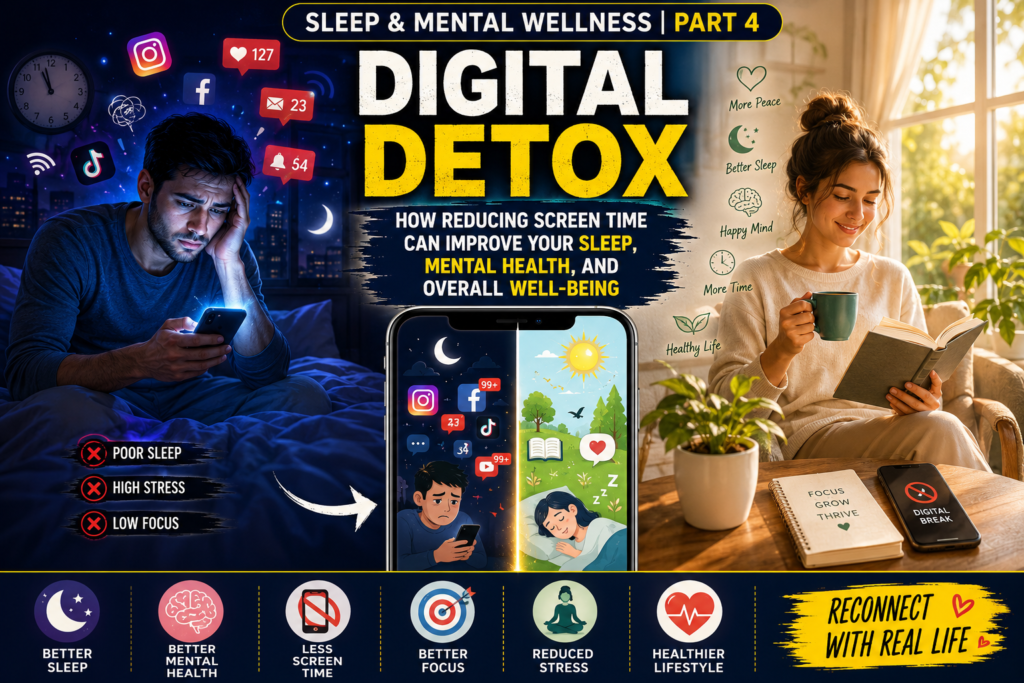
Around 90% of people in the world check their phones within the first 10 minutes of waking up in the morning. We complete a major part of our work through computers or mobiles, and until the very last moment before sleeping at night, scrolling through Facebook, Instagram, YouTube, X, or Shorts and Reels continues.
Technology has undoubtedly made our lives easier. We can connect with people anywhere in the world in just a few seconds; online education, office work, banking, shopping—everything is now at our fingertips. We have unconsciously become trapped in an invisible digital chain. Technology has increased our productivity, true, but it has silently stolen our deep night’s sleep, mental peace, and overall well-being.
Have you ever noticed that while using your mobile, even if you start thinking “just five minutes”, you don’t even realize when an hour passes? Again, after using the phone at night, falling asleep is often delayed, you feel tired upon waking up in the morning, concentration at work decreases, and irritability over small things increases. Excessive Screen Time can have a real impact on our body and brain. As a result, negative effects begin to show on real-life relationships, studies, work, sleep, and mental health.
The psychological and physical process of temporarily freeing oneself from this excessive screen time and the endless maze of technology is called “Digital Detox”.
In this episode of the Sleep & Mental Wellness series, we will learn—
- What is Digital Detox?
- Why is excessive Screen Time harmful?
- How does Screen Time affect sleep and mental health?
- What are the signs of Digital Addiction?
- How to start a Digital Detox in 15 easy ways
- Benefits of a Digital Detox
- When to seek professional help
What is Digital Detox?
By Digital Detox, we mean the practice of reducing or controlling the use of smartphones, computers, tablets, televisions, and other digital devices for a specific period of time.
It is a way to build a healthy relationship with technology.
The primary objectives of a Digital Detox are—
- Reducing Screen Time
- Reducing stress
- Ensuring good sleep
- Prioritizing real-life relationships
- Increasing focus and productivity
Why Has Our Screen Time Increased So Much?
In the current era, every task has now become digital.
For example—
- Online Class
- Work From Home
- Social Media
- Online Shopping
- OTT Platforms
- Mobile Gaming
- Digital Payments
As a result, we have started spending much more time in front of the screen than necessary, which keeps us hooked onto the screen for an even longer time.
How Does Screen Addiction Develop?
A chemical called Dopamine is released in our brain. This creates a feel-good sensation. When we scroll through social media, a sense of pleasure is created with the help of Dopamine. Consequently, the brain wants to check the phone repeatedly to get that same feeling again. Gradually, this turns into a habit and, in many cases, can develop into a type of Digital Addiction.
How Does Screen Time Affect Sleep, Mental, and Physical Health?
Although digital devices make our work easier, their excessive use can cast negative effects on mental and physical health.
1. Destroying Our Sleep
When we scroll through social media shorts or reels before sleeping, we think we are relaxing our body. But from a psychological standpoint, it does exactly the opposite. Blue Light or blue light is emitted from the screens of our smartphones, tablets, laptops, and LED TVs. At night, this light can disrupt our body’s natural sleeping process. There is a hormone in our body called Melatonin that prepares us for sleep. But using a mobile or laptop for a long time before sleeping sends a wrong signal to the brain that it is still daytime. As a result, the secretion of Melatonin can decrease, and sleep is delayed.
2. Increased Stress
Office emails, countless notifications, and the pressure of being online all the time can increase mental fatigue for many.
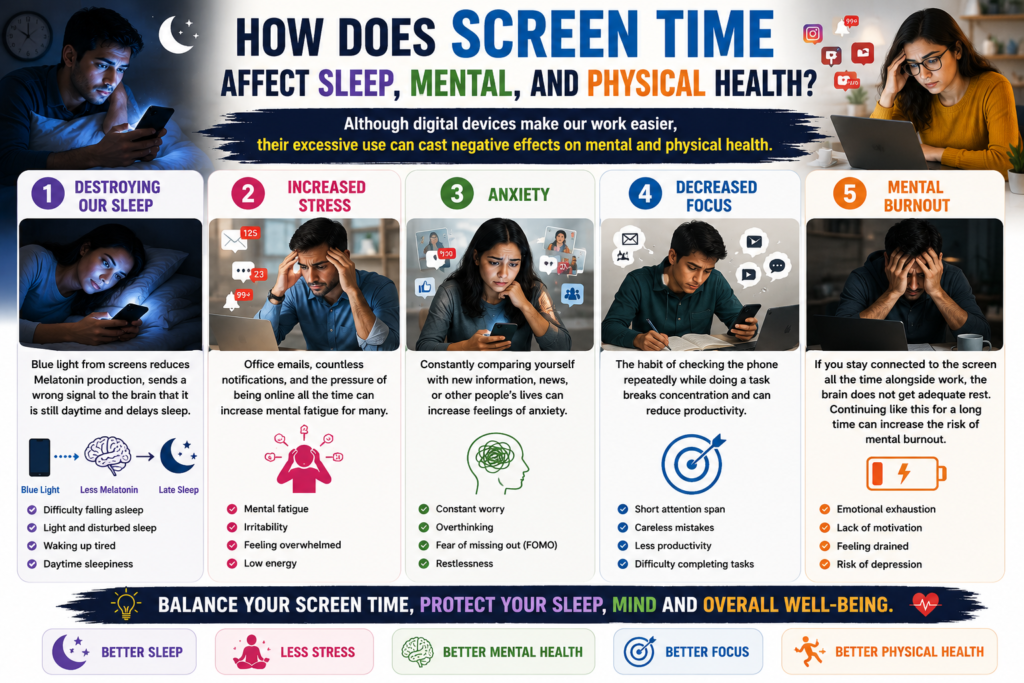
3. Anxiety
Constantly comparing yourself with new information, news, or other people’s lives can increase feelings of anxiety.
4. Decreased Focus
The habit of checking the phone repeatedly while doing a task breaks concentration and can reduce productivity.
5. Mental Burnout
If you stay connected to the screen all the time alongside work, the brain does not get adequate rest. Continuing like this for a long time can increase the risk of mental burnout.
Do You Need a Digital Detox?
If a few of the following symptoms match with you, then it might be time to start a Digital Detox:
- You check your mobile first thing upon waking up.
- You use your phone for a long time before sleeping.
- You check your phone repeatedly even when no notifications arrive.
- You use your phone even while talking to family or friends.
- You feel restless without your phone.
- You try to reduce your Screen Time but do not succeed.
- You feel low or relatively frustrated after using Social Media.
15 Easy Ways to Start a Digital Detox
1. Track Your Screen Time
First, find out how many hours you use the screen daily. Many smartphones have a Screen Time or Digital Wellbeing feature, which can be used to get an idea about your habits.
2. Stop Using Screens Before Sleeping
Keep the first 60 minutes of the day and the last 60 minutes of the night completely screen-free. Instead of picking up the phone right after waking up in the morning, do some free-hand exercise or drink water. Keep the last hour of the night reserved for reading books, writing a diary, or talking to family.
3. Do Not Pick Up the Phone Right After Waking Up in the Morning
Do not start the day with notifications; around 90% of the notifications that come to our phones are unnecessary marketing. Instead, drink water, walk for a while, or meditate.
4. Turn Off Unnecessary Notifications
Go to your phone’s settings and completely turn off notifications for all apps except calls, emails, and essential messaging apps. This will reduce the tendency to pick up the phone unnecessarily.
5. Set a Fixed Time for Social Media Use
Instead of using Social Media whenever you want throughout the day, fix a specific time. This will reduce time waste and also increase focus.
6. Make Your Bedroom a ‘Digital Sanctuary’
Your bedroom is a place only for sleep and rest. Make it a rule that your phone or laptop charger will never be next to the bed; let it be in another corner of the room or in a drawer. When the device is not in front of your eyes or within reach, the habit of scrolling will stop naturally.
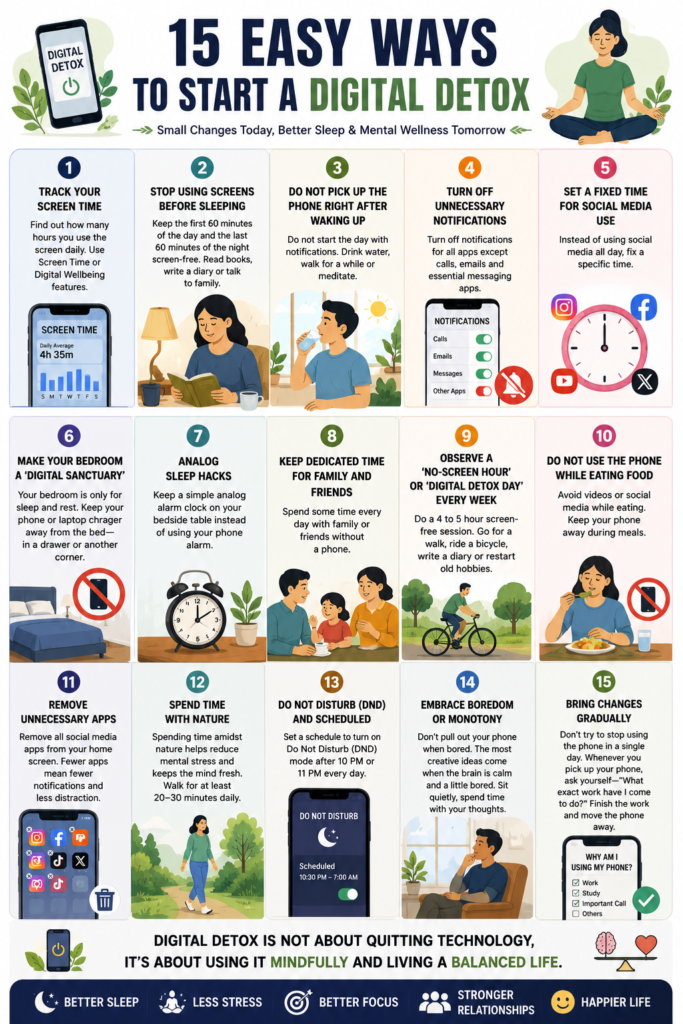
7. Analog Sleep Hacks
Many of us say, “An alarm is set on the phone, so it has to be kept close.” This is actually just a mental excuse. To eliminate this habit, keep a simple analog alarm clock on your bedside table.
8. Keep Dedicated Time for Family and Friends
Digital devices have brought many of us closer, but in many cases, they have distanced us from real relationships. Try to spend some time every day with family members or friends without a phone.
9. Observe a ‘No-Screen Hour’ or ‘Digital Detox Day’ Every Week
At the end of the week or on a holiday (like Sunday), do a weekend fasting of 4 to 5 hours continuously. Keep the phone completely turned off or on silent mode during this time. No social media or virtual world during this time; instead, go for a walk in a park, ride a bicycle, write a diary, or restart old hobbies anew.
10. Do Not Use the Phone While Eating Food
Many people watch videos or scroll through social media while eating. When you eat while looking at the screen, your brain cannot focus on the taste and amount of food. This not only disrupts focus but can also lead to a tendency to overeat at times. Therefore, make it a habit to keep the phone away during meals.
11. Remove Unnecessary Apps
Most of our phone use happens due to reflex or subconscious habits. To break this habit, remove all social media apps from your home screen. Fewer apps mean fewer notifications and less distraction.
12. Spend Time with Nature
Spending time amidst nature helps reduce mental stress and keeps the mind fresh. Try to walk in an open environment for at least 20–30 minutes daily.
13. Do Not Disturb (DND) and Scheduled
Set a schedule to automatically turn on Do Not Disturb (DND) mode on your phone every day after 10:00 PM or 11:00 PM. This will ensure that no unnecessary notifications or non-urgent call sounds disrupt your sleep cycle while sleeping at night.
14. Embrace Boredom or Monotony
Whenever your brain feels slightly bored, we pull the phone out of our pocket. Yet, a person’s most creative ideas come precisely when the brain is completely calm and a little bored. Do not fear boredom; sit quietly sometimes, spend time with your thoughts.
15. Bring Changes Gradually
Many try to stop using the phone completely in a single day. In reality, this is difficult for most people. Whenever you pick up the phone, ask yourself out loud—”Exactly what work have I come to do on the phone right now?” Lock the phone and move it away as soon as the work is finished.
Benefits of a Digital Detox
Building a habit of regular Digital Detox can show many positive changes. The benefits are—
- Good and deep sleep
- Helping to reduce mental stress
- Increase in focus and productivity
- Reducing eye strain
- Helping to reduce headache problems
- Increase in focus on work and studies
- Getting more time for oneself
- Balance is created in lifestyle
When Should Professional Help Be Taken?
If—
- Controlling phone use is absolutely not possible,
- Work or studies are disrupted due to Screen Time,
- Sleep problems persist for a long time,
- Anxiety, depression, or mental stress increases progressively,
- Real-life relationships start getting damaged,
Then advice should be taken from a qualified physician or mental health expert.
Conclusion
Technology was created to make our lives easier and save our time. But today we have become addicted to this screen. This didn’t happen in a single day. Without blaming yourself for this, start a small habit starting tonight. Like keeping the phone away before sleeping, turning off unnecessary notifications, and spending time with family without screens. To fully taste that beautiful life and bring back your peace of mind, turn off your screen for a while today. Take care of yourself, sleep peacefully, and stay mentally healthy.
Remember, your time is your most valuable asset.
FAQ
1. What is Digital Detox?
Ans. Digital Detox is the practice of consciously reducing the use of smartphones, computers, tablets, and other digital devices for a specific period of time to create a healthy digital balance.
2. Why is Digital Detox important?
Ans. Excessive Screen Time can cast a negative impact on sleep, mental health, focus, and physical well-being. Digital Detox helps reduce these effects and build a healthy lifestyle.
3. Can excessive Screen Time cause sleep problems?
Ans. Yes. Using mobiles or other screens for a long time before sleeping can decrease the secretion of the Melatonin hormone due to Blue Light, which can delay sleep and reduce sleep quality.
4. What is Blue Light?
Ans. Blue Light is a type of light emitted from smartphones, laptops, tablets, and LED screens.
5. How many hours of Screen Time should be consumed daily?
Ans. A specific time limit is not the same for everyone. However, keeping unnecessary Screen Time limited outside of work or studies and taking regular breaks is considered a healthy habit.
6. Does Digital Detox help reduce stress?
Ans. Yes. For many people, reducing Social Media and unnecessary Screen Time can be helpful in reducing stress, anxiety, and mental fatigue.
7. What is the easiest way to start a Digital Detox?
Ans. Stopping screen use at least 1 hour before sleeping, keeping unnecessary Notifications turned off, and fixing a specific time for Social Media use.
8. Is Digital Detox important for children and adolescents?
Ans. Yes. Excessive Screen Time can affect the sleep, studies, focus, and social development of children and adolescents. Therefore, building healthy Screen Habits for them is also important.
9. Do you have to stop using the phone completely during a Digital Detox?
Ans. No. The purpose of a Digital Detox is not to give up technology, but rather to use technology for necessary work while reducing unnecessary Screen Time and maintaining a healthy balance.
10. What are the benefits of a Digital Detox?
Ans. A Digital Detox can be helpful in ensuring good sleep, reducing stress, increasing focus, boosting productivity, reducing eye strain, improving real-life relationships, and maintaining overall mental well-being.
11. When should a doctor’s advice be taken?
Ans. If excessive Screen Time causes sleep problems, anxiety, depression, serious trouble in work or studies, or disrupts daily life, then advice should be taken from a qualified physician or mental health expert.
12. Is Digital Detox beneficial in the long term?
Ans. Yes. Regular habits of Digital Detox can play a positive role for many people in maintaining good sleep, improved mental health, greater focus, a better Work-Life Balance, and a healthy lifestyle.
13. Is it safe to use the phone at night if the phone’s ‘Night Mode’ or ‘Blue-Light Filter’ is turned on?
Ans. Night Mode or Blue-Light Filter can reduce the intensity of the screen’s blue light a bit to decrease strain on the eyes, but it cannot reduce your brain’s excitement (Cognitive Hyperarousal).
14. How long does it take to understand the benefits or positive changes of a digital detox?
Ans. If you can maintain a screen-free habit for just 3 to 5 days for 1 hour before sleeping and the first 1 hour after waking up, your sleep depth (Deep Sleep) will increase. Within a week, your morning fatigue will disappear, your energy level throughout the day will increase, and your mental focus will improve significantly.
Disclaimer
This article is intended for informational and educational purposes only and should not be considered medical advice, diagnosis, or treatment. The information shared is based on general health knowledge and reputable sources. Sleep needs and health conditions vary from person to person. If you experience persistent sleep problems, insomnia, breathing difficulties during sleep, or any other medical concerns, please consult a qualified healthcare professional. Always seek professional medical advice before making significant changes to your sleep habits or lifestyle.
The author and publisher shall not be held responsible for any loss, injury, damage, or adverse consequences resulting from the use, misuse, or interpretation of the information provided in this article. Readers are solely responsible for their own health-related decisions.