When we think about staying healthy, we usually think of a balanced diet, regular exercise, adequate sleep, reducing stress, and getting regular health checkups. But alongside these, immunization or getting vaccinated is also an essential part of preventive healthcare. Throughout the long history of human civilization, epidemics and infectious diseases have caused the premature deaths of millions of people. Humanity was once completely helpless in the face of deadly diseases like smallpox, polio, plague, tetanus, and measles. The single most successful innovation in medical science that brought modern humanity back to the light from that dark chapter is the vaccine or vaccination.
According to World Health Organization (WHO) estimates, thanks to modern vaccination, the precious lives of approximately 3.5 to 5 million people are saved worldwide every year. Many people assume that vaccines are primarily for children. Many also hold the belief that after receiving a few vaccines in childhood, there is no need for vaccines in adulthood. But in reality, at different stages of life, various vaccines may be required based on age, prior vaccination history, health conditions, pregnancy, occupation, travel, and specific health risks. The primary objective of a vaccine is to prepare the body’s immune system in advance against a specific infection, so that if exposed to that pathogen in the future, the body can respond quickly.
Vaccination is the backbone of preventive healthcare.
In this comprehensive guide, we will discuss why vaccines are important, their role in children and adults, why booster doses may be needed, common misconceptions about vaccines, and why you should maintain your vaccination records.
What Is a Vaccine and How Does It Provide Protection in the Human Body?
A vaccine is a biochemical substance that enters the body and trains our defense mechanism, or immune system, to fight against specific pathogens without the risk of actual disease. That is, our body’s immune system can recognize various pathogens and build a response against them. Vaccines help prepare that immune system in advance.
There are two main types of defense systems in our body’s blood—Innate Immunity and Adaptive Immunity.
1. The Role of Antigens and Antibody Production
Vaccines do not contain active, harmful pathogens. When this substance enters the body, our white blood cells recognize it as a foreign enemy and produce antibodies to fight against it.
2. Permanent Guarding by Memory Cells
Antibodies get stored for a lifetime within the body’s Memory B-cells and Memory T-cells. When a person is infected by a deadly pathogen present in the environment, the body’s memory cells recognize that pathogen in an instant. Even before the disease can produce symptoms in the body, they rapidly produce actual antibodies and destroy the pathogen. Consequently, the affected person does not fall ill.
Why Is Vaccination So Important?
The biggest advantage of vaccines is that they attempt to prevent disease before it occurs.
Vaccination—
- Can help reduce the risk of certain serious infections
- Can help reduce the risk of severe illness if infected
- Can assist in reducing complications of certain diseases
- Can help control the spread of infections
- Can help indirectly protect those whose immune system is weak or who may be at higher risk for infection
However, vaccine effectiveness may vary according to the disease, vaccine type, and the individual’s situation.
Vaccines Are Important for Adults Too, Not Just for Children
“I am grown up, so I don’t need any more vaccines”—this notion is not always correct. This is one of the most common misconceptions about vaccines.
Although vaccinating children on time is extremely important, the need for immunization does not completely end with increasing age. Certain vaccines may be necessary for adults as well. Moreover, for some vaccines, booster doses may be required after a specific period.
Vaccination Guidelines Across Different Life Stages: Who Needs Which Vaccine?
Vaccines are not merely a one-time chapter of childhood. As age increases, immunity declines, and antibody levels from childhood vaccines decrease in the blood. Therefore, people of every age group must receive certain specific vaccines.
1. Infancy & Childhood Vaccines
Many families do not remember vaccines after a child’s initial immunization. But in adolescence as well, certain vaccines or extra doses may be required. An important example of this is the HPV or Human Papillomavirus vaccine. According to the Expanded Programme on Immunization (EPI), the following vaccines are mandatory:
- BCG: Given immediately after birth to prevent tuberculosis (TB) and severe TB meningitis.
- Pentavalent Vaccine: Provides protection in a single injection against 5 deadly diseases—Diphtheria, Pertussis (whooping cough), Tetanus, Hepatitis B, and Haemophilus influenzae type b (which causes pneumonia and meningitis in children).
- Polio Vaccine (OPV & IPV): Given via oral drops and injections to completely eradicate poliomyelitis.
- PCV (Pneumococcal Conjugate Vaccine): Protects children’s lungs and brain against Streptococcus pneumoniae bacteria.
- Rotavirus Vaccine: Given to prevent diarrhea in infants.
- MR / MMR: Builds lifelong immunity against Measles, Mumps, and Rubella.
2. Adolescence & Young Adulthood Vaccines
To maintain strong immunity after childhood, it is essential to take the following vaccines:
- HPV Vaccine: Most ideal for daughters and sons aged 9 to 14. HPV or Human Papillomavirus is a common virus. Some of its strains can be linked to certain cancers in the long term. Therefore, vaccination against HPV is an important aspect of preventive healthcare.
- Td / Tdap Booster: A booster dose for tetanus and whooping cough should be taken at age 10 and every 10 years thereafter.
- Meningococcal Vaccine: Very useful for youths staying in colleges, universities, or hostels to protect against severe bacterial meningitis.
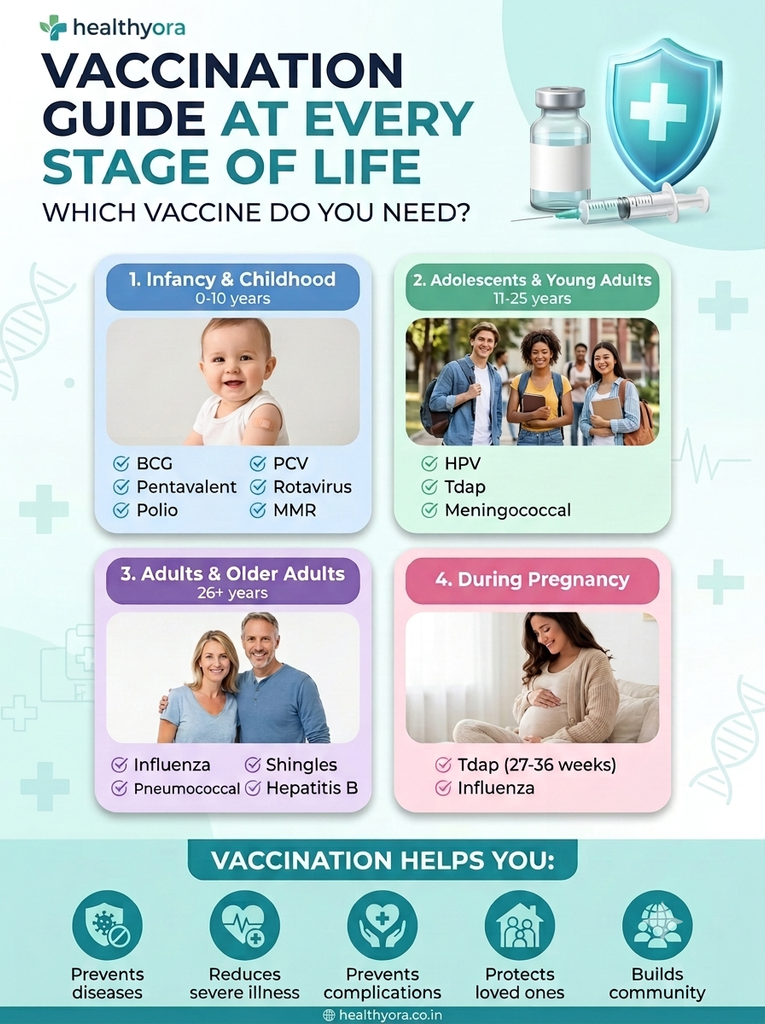
3. Vaccination for Older Adults
With advancing age, the risk of serious complications for certain infections can increase. For this reason, specific vaccines may be recommended for older adults based on age:
- Annual Flu Vaccine: Patients with diabetes, high blood pressure, asthma, or kidney disease, in particular, should take a flu shot at the beginning of winter every year.
- Pneumococcal Vaccine (PCV13 / PPSV23): Taking this vaccine is crucial for seniors aged 65 and older, and chronic patients over 50, to prevent bacterial pneumonia and sepsis (blood poisoning).
- Shingles Vaccine (Shingrix): In people who had chickenpox in childhood, the virus can often reactivate after age 50 as immunity declines. Taking the Shingrix vaccine can prevent this unbearable nerve disease in 97% of cases.
- Hepatitis A & B: For any adult who did not receive these vaccines in childhood, these doses should be completed to prevent jaundice, liver failure, and cirrhosis.
4. Vaccination During Pregnancy
Vaccination during pregnancy is a special consideration. Some vaccines can be beneficial or recommended during pregnancy, while certain vaccines are typically avoided. Therefore, while pregnant, no vaccine should be taken or omitted based on one’s own decision.
- Tetanus Toxoid or Tdap (Td / Tdap): Taking the Tdap vaccine between 27 to 36 weeks of pregnancy keeps the mother free from tetanus.
- Flu Shot (Influenza Vaccine): During pregnancy, a woman’s immunity is somewhat sensitive. Taking a flu shot protects the pregnant mother from risks of severe pneumonia and premature delivery.
Some Notable Vaccinations
1. Flu or Influenza Vaccine
Many consider the flu to be like a common cold. But influenza can cause severe illness in certain individuals. The influenza virus and vaccine recommendations can change over time. Therefore, it is best to consult a doctor regarding who the flu vaccine is suitable for and when.
2. Tetanus Vaccine
Tetanus is a serious bacterial infection that can affect the nervous system. Many believe that after getting vaccinated in childhood, there is no need to worry about tetanus anymore. But even in adults, booster doses of tetanus-containing vaccines may be required at specified intervals. In the event of an accident or injury, knowing when your last tetanus shot was taken makes it easier for the doctor to make a decision.
3. Pneumococcal Vaccine
Pneumococcal bacteria can cause pneumonia and other serious infections. However, this vaccine is not needed by everyone at the same time.
What Is a Booster Dose and Why Might It Be Needed?
For some vaccines, an additional dose may be required at a specific time after the initial doses. This is commonly referred to as a booster dose. Its purpose is to help maintain or further strengthen the immunity built in the body. Therefore, there is no universal rule that “once vaccinated, it is never needed again for life.”
What Side Effects Can Occur After Vaccination?
After receiving a vaccine, some people may experience temporary, mild side effects.
Such as:
- Pain at the injection site
- Mild swelling
- Low-grade fever
- Feeling weak
- Body ache
In most cases, these are temporary and subside within a short period. However, if any unusual or severe reaction appears, medical advice should be sought promptly.
Maintain Your Vaccination Record
Vaccination records are not important only for children. They can be useful even in adulthood.
If possible, keep in your records:
- Name of the vaccine
- Date administered
- Dose number
- Expected date of the next dose
- Location where the vaccine was administered
If you have old vaccination cards, hospital papers, or digital records, keep them safely stored.
Common Misconceptions About Vaccines
- Misconception 1: Vaccines are only for children
This is not correct. In addition to children, adults and the elderly may also require certain vaccines based on age and risk. - Misconception 2: I am healthy, so I do not need vaccines
Being healthy is certainly good. But the purpose of vaccines is to prepare the body before infection occurs. - Misconception 3: “There is no need to get vaccinated against diseases that are nearly eradicated from society.”
Scientific Truth: Diseases have decreased in society because people consistently get vaccinated. If people stop getting vaccinated, dormant pathogens or those from abroad will return and cause epidemics. For example, due to falling vaccination rates in some countries recently, outbreaks of measles and polio have re-emerged. - Misconception 4: If you get vaccinated, you will never get the disease
Vaccines can help reduce the risk of disease or the risk of severe illness. But no vaccine should be viewed as a 100% guarantee. - Misconception 5: “People can even die from vaccine side effects.”
Scientific Truth: Common side effects of vaccines are slight pain at the injection site, redness, or a mild fever for 1–2 days. This is not a sign of danger; rather, it proves that your immune system is actively responding against the vaccine’s antigen and producing antibodies.
Vaccination should not be viewed as limited to just a few childhood vaccines. At different stages of life, our health and risks change. Accordingly, the necessity of certain vaccines can change as well. Preserve your vaccination records; if any dose is missed, discuss it with a doctor. The primary goal of preventive healthcare is not merely receiving treatment after falling ill, but striving to reduce risks before the disease occurs.
Stay healthy, stay protected, and do your part in building a disease-free, confident society!
Frequently Asked Questions
1. Are vaccines only for children?
Ans. No. Although childhood vaccination is extremely important, adults and the elderly may also need certain vaccines based on age and health risks.
2. Do you have to take vaccines every year?
Ans. No. The rules for all vaccines are not the same. For some vaccines, an annual shot may be required, while for others, multiple doses or a booster dose after a specific period may be needed.
3. Is the HPV vaccine only for girls? Can boys take it?
Answer: The HPV vaccine is equally important for both boys and girls. Just as it prevents cervical cancer in women, it also protects against cancers of the throat, oral cavity, and genitals in males.
4. Can other routine vaccines be taken after receiving the COVID-19 vaccine?
Answer: Yes, absolutely. According to modern medical guidelines, taking any other routine vaccine (such as flu or Tdap) on the same day or on different days along with the COVID vaccine is completely safe.
5. Is vaccination important if you have diabetes?
Ans. In certain chronic health conditions, the risk of complications from specific infections may be higher. Therefore, if you have diabetes, it is advisable to discuss your vaccination needs with a doctor.
6. Should one be scared if a mild fever occurs after taking a vaccine?
Ans. After certain vaccines, mild fever, body ache, or pain at the injection site can occur, and in most cases, these are temporary. However, if a severe or unusual reaction occurs, consult a doctor.
7. Should you get vaccinated on your own whim?
Ans. Which vaccine is suitable for you, how many doses are needed, and when to take them can vary from person to person. Therefore, it is best to seek advice from a qualified doctor or immunization specialist.
Disclaimer
The information provided in this article is for educational and informational purposes only and should not be considered medical advice, diagnosis, or treatment. Always consult a qualified doctor or healthcare professional regarding any medical concerns, symptoms, or before making changes to your diet, exercise, or treatment plan. Never ignore professional medical advice or delay seeking treatment based on information from this website. Healthyora and the author are not responsible for any decisions or actions taken based on the content of this article.