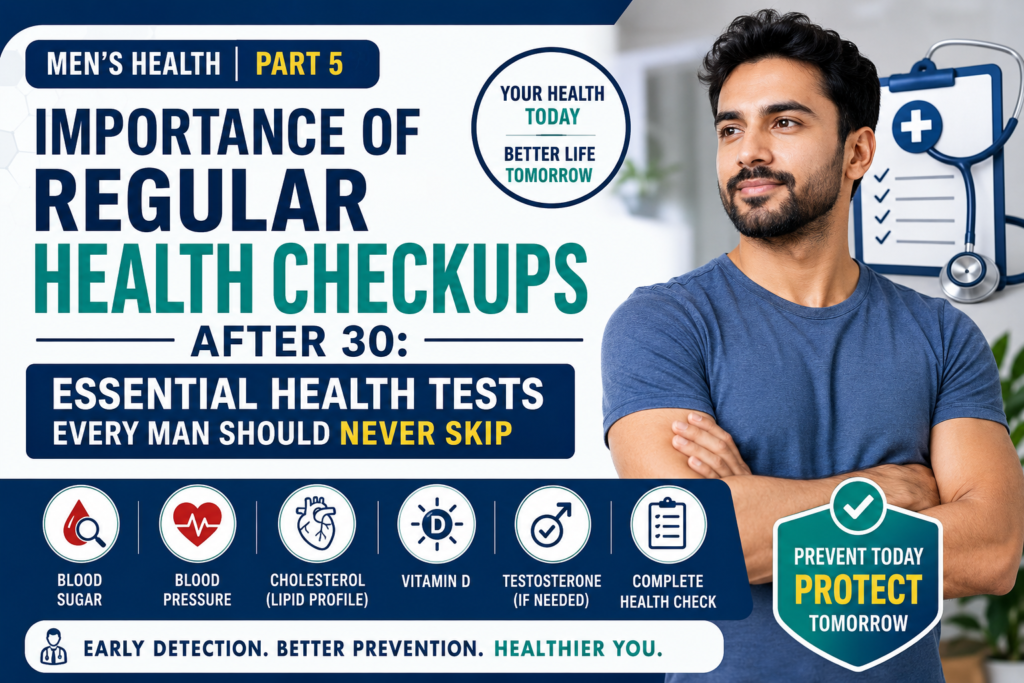
After crossing the age of 30, various physiological changes gradually begin in men’s bodies. These changes do not happen overnight; rather, they occur slowly over the years. Most men hold a misconception—”I am completely fit from the outside, I don’t have any pain or suffering, so why should I go to the hospital and get tested for no reason?”
That is why a Regular Health Checkup is not only for sick people, but also extremely important for healthy people. Regular health checkups allow risks to be identified before a disease begins, necessary lifestyle changes to be made, and quick treatment to start if needed. This can largely prevent major future complications such as heart disease, stroke, kidney disease, or diabetes-related issues.
One thing should always be kept in mind—a regular health checkup is not an extra expense, but rather the best investment for your future life, work productivity, and family’s security.
In this blog, we will learn—
- Why Regular Health Checkup is so important after the age of 30.
- Which health tests can be beneficial for men.
- How regular health checkups can help maintain a healthy and active life in the long run.
Why is regular health checkup mandatory after 30?
When we step into the age of 30, the internal metabolism, hormone secretion, and rate of cellular regeneration in our body change.
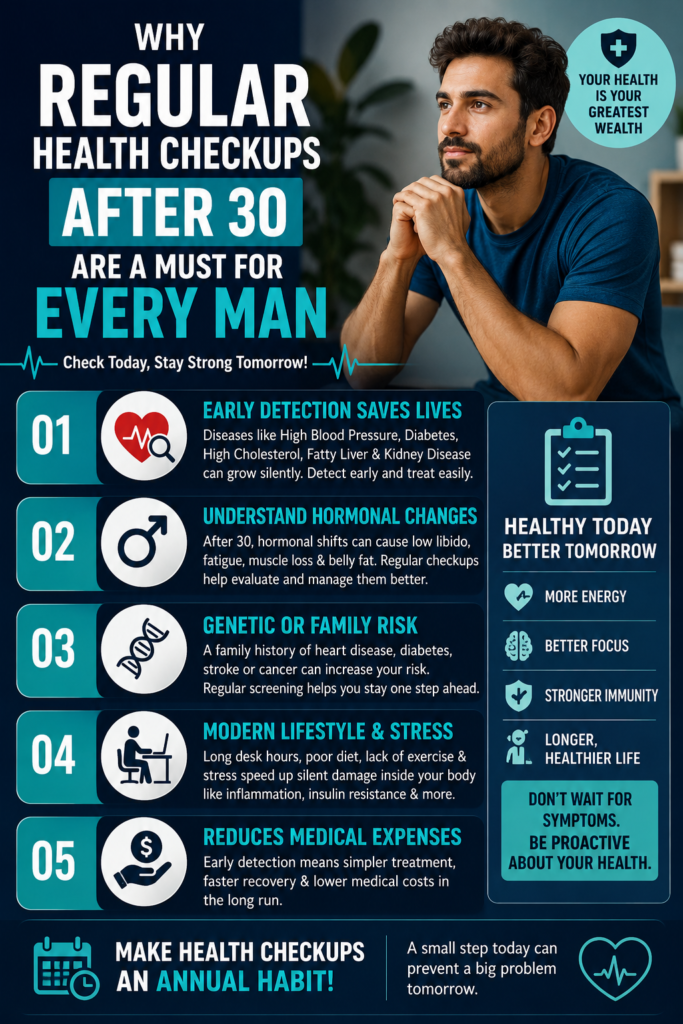
1. Early Detection Saves Lives
Any serious disease such as High Blood Pressure, Type 2 Diabetes, High Cholesterol, Fatty Liver, or Kidney Disease often damages the body silently for years. Therefore, if caught early, a 100% cure is possible through simple dietary changes, lifestyle modification, or minimal medical treatment. But after the disease takes a complex form, treatment becomes much more difficult, painful, and expensive.
2. Hormonal Changes Become Easier to Understand
After the age of 30, some men may experience Hormonal changes. Such as:
- Decreased libido
- Extreme fatigue
- Loss of muscle mass
- Increased belly fat
If these symptoms are present, a doctor can advise a Hormone Evaluation as needed.
3. Hereditary or Genetic Risk (Family History)
If your family has a history of heart disease, high blood pressure, stroke, cancer, or diabetes, your risk of developing those diseases doubles after the age of 30. Regular screening tests can identify these genetic risks in advance.
4. Modern Sedentary Lifestyle and Stress
Most men in today’s modern era sit at a desk all day to work, remain physically inactive, consume more processed and fast food, and are under constant career and financial stress. This lifestyle unknowingly accelerates insulin resistance, chronic inflammation, and fat deposition in arteries within our bodies.
5. Can Help Reduce Medical Expenses
Many people visit a doctor after falling ill. But when a disease becomes complex, the cost of treatment also increases significantly. On the other hand, regular health checkups can detect diseases at an early stage. In many cases, it is possible to keep the situation under control through simple treatment and healthy living.
Remember: Regular Health Checkup does not just mean searching for diseases; rather, it creates an opportunity to prevent future diseases. Consulting a doctor once a year to get necessary health tests done allows many problems to be identified at an early stage.
Essential Health Tests Every Man Should Never Skip
If your age is 30 or above, it is extremely important to get the following tests done regularly to ensure the health of specific organs:
1. Complete Blood Count (CBC)
CBC is an important blood test through which you can know about:
Why it is essential: Anemia, possibility of infection, exact platelet status, and overall blood health. Often, the cause of long-term fatigue or weakness can be caught in a CBC test.
2. Urine Routine Examination and Microscopy
A lot of important information can be obtained from just a simple Urine Test.
Why it is essential: Whether protein or albumin is leaking through the kidneys (which is an early sign of kidney failure), urinary tract infections (UTI), or the presence of blood cells or sugar can easily be detected in this test.
3. Blood Pressure and ECG
High Blood Pressure is called a “Silent Killer” because it can damage the body for years without any symptoms.
Why it is essential: High blood pressure is the main cause of heart attack and stroke. It can damage the kidneys and the retina of the eyes. Therefore, BP should be checked at least once a month. In addition, an electrocardiogram or ECG should be done at least once a year, which helps detect heart electrical activity and irregular heartbeats.
4. Blood Sugar and HbA1c (Diabetes Screening)
Currently, Type-2 diabetes is increasing epidemically among young and middle-aged men.
Why it is essential: It is not enough to just test Fasting Blood Sugar; it is necessary to perform an HbA1c test to know the average blood sugar level over the past 3 months. Fasting blood sugar below 110 mg/dL and HbA1c below 5.7% is considered normal. If it is between 5.7% and 6.4%, it is called ‘pre-diabetes’.
5. Lipid Profile Test
What is checked: Total Cholesterol, LDL (bad cholesterol), HDL (good cholesterol), and Triglycerides.
Why it is essential: Men with abdominal fat or a belly have a higher risk of elevated triglycerides and LDL, which directly increases the risk of a heart attack manifold.
6. Liver Function Test (LFT) and USG of Whole Abdomen
Due to unhealthy eating habits and excessive alcohol consumption, accumulation of fat in the liver or Fatty Liver has become a very common problem.
Why it is essential: Through LFT tests (SGOT, SGPT, Bilirubin), liver enzymes are examined. And through ultrasonography (USG) of the abdomen, the actual grade of fatty liver (Grade 1/2), gallstones, and kidney stones can be directly seen and confirmed.
7. Kidney Function Test (KFT)
The kidney removes waste products from the body and helps maintain the balance of body fluids and electrolytes.
What is checked: Serum Creatinine, Urea, and Uric Acid.
Why it is essential: If blood pressure or sugar remains uncontrolled for a long time, the kidneys silently begin to fail. The filtering capacity of the kidneys is understood through the creatinine test.
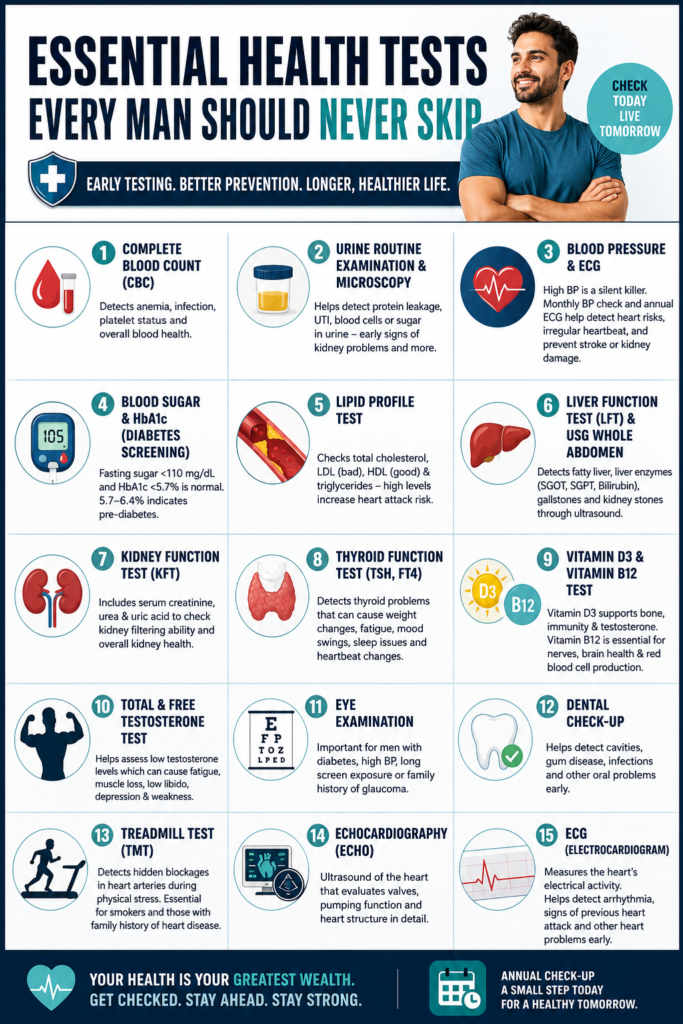
8. Thyroid Function Test (TSH, FT4)
Thyroid hormone controls the body’s Metabolism.
Why it is essential: If there are thyroid problems, the following may occur—abnormal weight gain or loss, extreme fatigue, sleep issues, low mood, and changes in heart rate.
9. Vitamin D3 and Vitamin B12 Test
Vitamin D is not just for bones; it is important for immunity, muscle function, and overall health. On the other hand, Vitamin B12 plays a crucial role in the nervous system, brain, and red blood cell production.
Why it is essential: Vitamin D3 helps increase testosterone levels and strengthen bones. And Vitamin B12 is needed for the health of our nervous system and brain. B12 deficiency leads to tingling in hands and feet, nerve weakness, and memory decline.
10. Total and Free Testosterone Test (Testosterone Level)
After the age of 30, testosterone secretion naturally decreases in men’s bodies.
Why it is essential: If this hormone drops excessively due to extreme stress and a poor lifestyle, physical weakness, muscle loss, depression, and sexual capability or libido drop suddenly. Measuring it and taking correct steps is essential.
11. Eye Examination
Regular eye tests are also important after 30.
Why it is essential: Especially those who have Diabetes, High Blood Pressure, work on computers for long hours, or have a family history of Glaucoma should get regular Eye Check-ups as advised by a doctor.
12. Dental Check-up
Many people do not give importance to dental health.
Why it is essential: With regular Dental Check-ups—tooth decay, gum disease, and mouth infections can be identified in early stages.
13. Treadmill Test or TMT (Cardiac Stress Test)
Through Treadmill Test (TMT) or Stress Test, how the heart functions during exercise is evaluated.
Why it is essential: Often, a simple ECG shows completely normal results while at rest. But when the body exerts itself, whether there is any hidden block in blood flow to the heart can be caught by making the person walk on a treadmill during a TMT test. It is especially essential for smokers or those with a family history of heart attack.
14. Echocardiography (Echo)
Echo is a method of examining the heart through ultrasound.
Why it is essential: It provides detailed insights into the heart’s valves, pumping capacity, and structure.
15. ECG (Electrocardiogram)
ECG tests the electrical activity of the heart. Those who have chest pain, heart palpitations, shortness of breath, high blood pressure, or a family history of heart disease can get this done on a doctor’s advice.
Why it is essential: It helps in the initial evaluation of heartbeat irregularities (Arrhythmia), signs of past Heart Attacks, and other cardiac issues.

Things to Do Before and After Medical Tests
It is essential to follow certain rules to get accurate results during health checkups:
1. Proper Fasting
For sugar, lipid profile, and LFT tests, one needs to fast for 8 to 12 hours the night before the test. During fasting, only a little plain water can be consumed.
Keeping track of medications: If you are already taking any regular medication (such as blood pressure medicine), consult with the lab or doctor whether to take it on the morning of the test.
2. Avoid Alcohol and Heavy Exercise
Alcohol consumption and very heavy gym or workout sessions should be avoided at least 24-48 hours before the test, otherwise the LFT or uric acid reports may show incorrect results.
3. Show Reports to an Experienced Doctor
Show your reports to a qualified general physician or specialist doctor to get proper treatment or lifestyle guidance.
Conclusion
Crossing 30 years of age means becoming more responsible towards your own life and family. Instead of waiting until a disease becomes severe, build a conscious mindset to prevent disease. Take out just one day a year to get basic health tests done.
Remember, a Regular Health Check-up is not something to fear—it is a responsibility toward yourself and your family. Take a small step for your health today. Because prevention is always better than cure.
Frequently Asked Questions (FAQ)
1. Do I really need to get tested if I have no disease or pain in my body?
Answer: Absolutely required. Because high blood pressure, high cholesterol, pre-diabetes, fatty liver, and early kidney problems do not produce any pain or early symptoms in the body.
2. How much can a full body checkup cost?
Answer: Rates vary across different pathology labs or hospitals, and there are specific ‘Master Health Checkup Packages’ for men over 30. Spending this small diagnostic amount annually is a very wise move compared to spending lakhs in the hospital after developing an unnecessarily complex disease.
3. What is the correct rule for testing blood sugar?
Answer: For a fasting blood sugar test, you must remain on an empty stomach for at least 8 to 10 hours after eating dinner at night. After giving the blood sample the next morning, the ‘Post Prandial (PP)’ sugar test is done exactly 2 hours after lunch.
4. Can a Regular Health Check-up prevent all diseases?
Answer: No. A health checkup cannot prevent all diseases. However, it helps detect many diseases at an early stage.
5. Is a full Health Check-up completed just by doing a Blood Test?
Answer: No. A comprehensive Health Check-up may include a physician’s physical exam, Blood Pressure, weight, BMI, lifestyle assessment, and other tests as needed.
6. Should screening be started earlier if there is a Family History?
Answer: Yes. If there is a history of Diabetes, Heart Disease, Stroke, High Blood Pressure, or certain types of Cancer in the family, your risk may be higher. In this case, starting screening relatively earlier or doing it regularly as per doctor’s advice can be beneficial.
7. Should all men get a PSA test after 30?
Answer: No, generally a PSA test is not necessary for everyone after 30. However, if you are over 40 or have a family history of prostate cancer, or experience frequent urination at night, you should get a PSA test done after consulting a urologist.
8. Who should get a TMT or Cardiac Stress Test?
Answer: For those who have crossed 30 years of age, smoke regularly, have high blood pressure or cholesterol, or have a family history of early heart attack, getting a TMT test done once a year or before starting gym is extremely safe.
Disclaimer
The information provided in this article is for educational and informational purposes only and should not be considered medical advice, diagnosis, or treatment. Always consult a qualified doctor or healthcare professional regarding any medical concerns, symptoms, or before making changes to your diet, exercise, or treatment plan. Never ignore professional medical advice or delay seeking treatment based on information from this website. Healthyora and the author are not responsible for any decisions or actions taken based on the content of this article.