
In a woman’s life, amidst managing family, work, studies, children, relationships, and various responsibilities, taking care of oneself often takes a back seat. Yet to stay healthy, just taking care of others is not enough—taking care of one’s own body and mind is equally important. In the minds of most women, when trying to find a little time for themselves, a strange sense of guilt works—”If I give time to myself, won’t my family members be neglected?”
Self-care does not mean just skincare, makeup, or a beauty routine. It is a combination of certain daily habits that help keep the body, mind, sleep, diet, hygiene, and overall well-being in good shape.
In this detailed guide, we will discuss the true scientific foundation of self-care in women’s lives, the challenges of self-care for working women versus homemakers, and 15 extremely simple and effective daily habits.
The 4 Scientific and Psychological Pillars of Self-Care
The concept of self-care is not limited merely to skin or hair care. Self-care is essentially established on four primary pillars:
1. Physical Self-Care
Keeping the body functional with proper nutrition, providing adequate rest when fatigued, and getting prompt medical treatment when ill are parts of physical self-care.
2. Emotional Self-Care
Expressing inner negative emotions without suppressing them, avoiding excessive work pressure, and abandoning the tendency to unnecessarily please everyone.
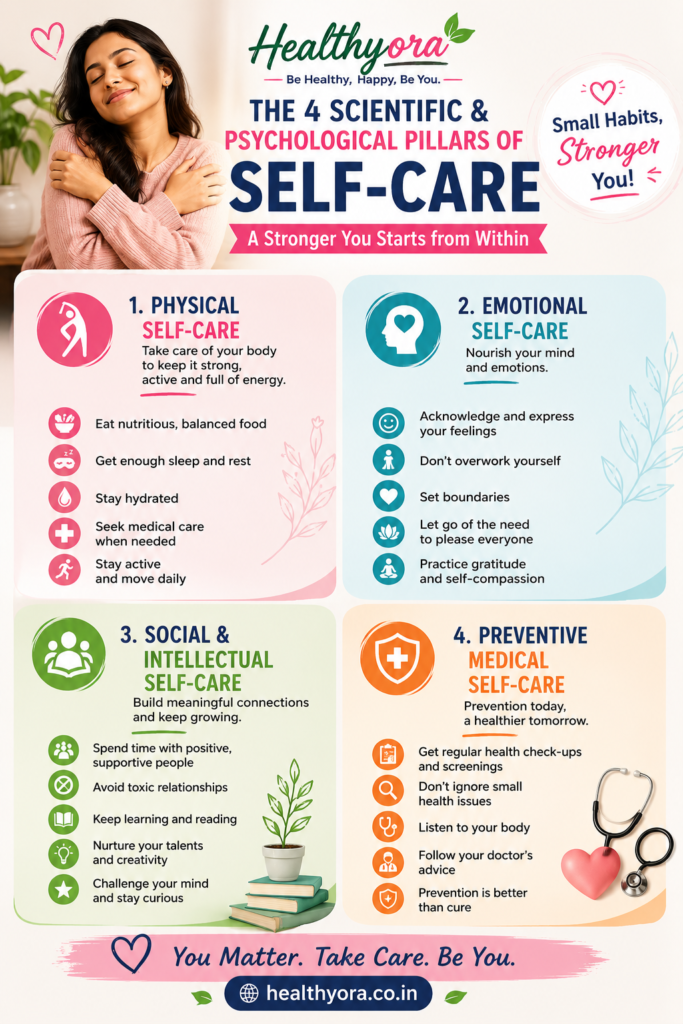
3. Social & Intellectual Self-Care
Staying away from relationships that drain mental energy (Toxic Relationships) and actively practicing one’s intellect, studies, and latent talents.
4. Preventive Medical Self-Care
Undergoing regular screening tests of the body even while healthy, not hiding small health issues, and not ignoring medical advice.
15 Simple and Scientific Self-Care Habits Every Woman Should Follow
Setting aside some time for yourself every day is not selfish. Rather, it is an important habit for a long-term healthy, active, and balanced lifestyle.
1.Start Your Day with a Healthy Routine
After waking up in the morning, drink some water and slowly start the day’s work. This will activate your digestive system, rehydrate your body, and prepare your mind for the day’s work. Instead of scrolling social media for a long time right after waking up in the morning, you can do a few minutes of stretching, walking, or planning the day’s tasks.
Recommended: Stay hydrated with this reusable water bottle.
👇🏼👇🏼
2. Never Ignore a Balanced Diet
One of the most important parts of self-care is nutritious food. Try to keep various types of food in your daily diet:
3. Make Daily Physical Activity a Habit
You don’t always need a gym to exercise. Choose any physical activity of your choice for at least 30 minutes every day. Such as brisk walking, yoga, free-hand exercise, or light stretching.
4. Set Healthy Boundaries & Learn to Say ‘No’
It is not possible to keep everyone happy all the time. If you become physically or emotionally exhausted due to taking on extra responsibilities in family, workplace, or social life, learn to politely say “No” when necessary. Respecting your own physical and mental capacity is self-care.
5. Give Sleep the Importance It Deserves
Sleep is extremely important for body and mind recovery. Adults generally may need about 7–9 hours of sleep per night, although needs vary from person to person.
6. Create a Digital Detox Routine
Mobile phones, social media, streaming, and constant notifications have become part of our daily lives. But constantly staying in front of screens damages the eyes due to artificial blue light and causes insomnia by blocking the secretion of the melatonin hormone. Therefore, keep mobile, laptop, or TV screens completely off at least 1 hour before sleeping at night and for the first half-hour after waking up in the morning.
7. Listen to Body Signals & Reduce Dependence on Painkillers
Do not pop painkillers like snacks whenever you experience lower abdominal pain, back pain, extreme fatigue, or any discomfort. When the body gives discomfort signals, understand that it is asking for rest. Without ignoring these signals of the body, take rest when needed and consult a doctor.
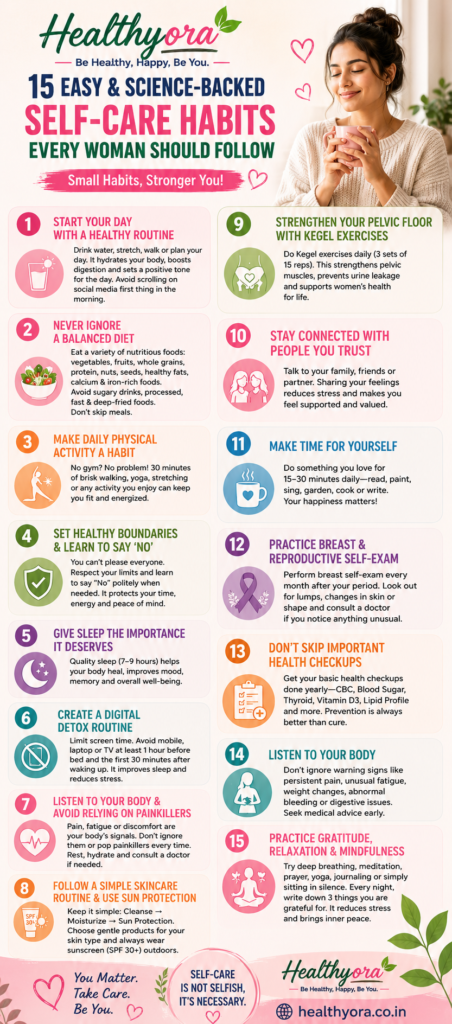
8. Regular but Simple Skincare & Sun Protection
It is not necessary to use many expensive products for healthy skin. A simple skincare routine can be: Cleanse → Moisturize → Sun Protection. Choose gentle products according to your skin type. Always use sunscreen (SPF 30+) during the day before going out.
9. Kegel Exercises to Strengthen Pelvic Floor
With childbirth and aging, women’s lower abdominal and pelvic floor muscles become weak. As a result, problems like leaking urine while sneezing or coughing occur. Perform Kegel exercises in 3 sets of 15 reps at any time of the day while sitting or lying down (squeezing and holding the muscles for 5 seconds as if holding urine, and then releasing). This will keep the pelvic muscles strong for a lifetime.
10. Stay Connected with People You Trust
Self-care does not mean handling everything alone. Talk regularly with a trusted family member, friend, or partner. Sometimes, just talking about your problems helps reduce mental stress to some extent.
11. Make Time for Yourself
Many women do not get time for themselves while prioritizing others’ needs all day. Try to set aside at least 15–30 minutes every day for an activity of your choice for any hobby such as singing, painting, reading books, gardening, learning a new recipe, or writing.
12. Breast & Reproductive Self-Examination
Stand in front of a mirror one week after your period ends every month to do a Breast Self-Examination. If you notice any lump, hard mass, or skin change, consult a doctor promptly. Awareness is the best way to survive breast cancer.
13. Don’t Skip Important Health Checkups
Rather than rushing to the hospital after falling ill, get basic blood tests done (e.g., CBC, Blood Sugar, Thyroid, Vitamin D3, Lipid Profile) at least once a year while healthy, upon a doctor’s advice.
14. Listen to Your Body
Due to busyness, many women ignore the body’s warning signs. But persistent pain, unusual fatigue, unexplained weight change, abnormal bleeding, chronic digestive issues, or any new change in the body should not always be assumed to be “normal.”
15. Express Gratitude, Practice Relaxation and Mindfulness
For some time of daily relaxation, you can choose whichever method is comfortable for you—Deep breathing, meditation, prayer, gentle yoga, journaling, or simply sitting quietly for a while. Also, every night before going to sleep, write down 3 things in a notebook for which you are grateful to the Creator or to life. Instead of calculating what you didn’t get all day, focusing on what you received reduces brain stress and restores mental tranquility.
Common Mistakes in Self-Care Practice to Avoid
Many women start self-care but get frustrated midway due to some misconceptions:
- Mistake 1: Seeking excessive perfectionism: Self-care is not an exam; do not feel guilty if you miss exercise on some days; start again the next day.
- Mistake 2: Comparing with social media: Do not get influenced by watching reels on social media; whatever brings you peace is your real self-care.
- Mistake 3: Mindset of overspending: There is no need to go to expensive clubs or buy spa packages for self-care; sitting on the balcony at home and breathing in the open air is the most powerful self-care.
- Mistake 4: Making the excuse of not having time: If you cannot find just 20–30 minutes a day for yourself, it is not a lack of time, but a lack of priority for self-love.
Conclusion
Self-care is not a luxury, and it is not just a beauty routine either. It is a healthy approach to prioritizing the needs of one’s own body and mind. Allocate just half an hour every day entirely for your own wellness and peace. Love yourself, take care of yourself, and enjoy the joy of a vibrant, long, and dignified life!
Most importantly, you don’t need a perfect routine to take care of yourself. Start small, build habits according to your routine, and maintain them consistently.
Frequently Asked Questions
1. Is self-care just a skincare or beauty routine?
Ans. No. Self-care includes nutrition, sleep, exercise, hygiene, emotional well-being, boundaries, and healthcare—all of it.
2. How much time should be kept for self-care every day?
Ans. There is no specific timeframe. You can start with 15–30 minutes every day. Consistency is more important than duration.
3. Is self-care possible only if you have money?
Answer: Not at all. The most effective self-care habits—such as drinking enough water, sleeping on time, getting morning sunlight, doing light stretching at home, and talking calmly with people—cost no money.
4. What should self-care look like during women’s period days?
Answer: During periods, the body expends extra energy. Therefore, the best self-care during these days is avoiding heavy work and getting adequate rest, applying a warm compress to the lower abdomen, eating iron-rich foods, and doing light stretching or walking.
5. Why is separate exercise necessary for women’s physical fitness outside household chores?
Answer: Doing household chores certainly tires the body, but it does not provide balanced exercise for all muscles or cardiovascular improvement. Doing brisk walking or stretching separately for 20–30 minutes daily keeps the heart healthy and maintains bone density.
6. How to do self-care when very busy?
Ans. Start with small habits. Such as taking a short walking break amidst work, drinking enough water, having a nutritious breakfast, and maintaining a set bedtime.
7. When should professional help be sought?
Ans. When any physical or emotional symptom is long-lasting, increases, or affects daily life, help from a healthcare professional should be sought.
Disclaimer
The information provided in this article is for educational and informational purposes only and should not be considered medical advice, diagnosis, or treatment. Always consult a qualified doctor or healthcare professional regarding any medical concerns, symptoms, or before making changes to your diet, exercise, or treatment plan. Never ignore professional medical advice or delay seeking treatment based on information from this website. Healthyora and the author are not responsible for any decisions or actions taken based on the content of this article.