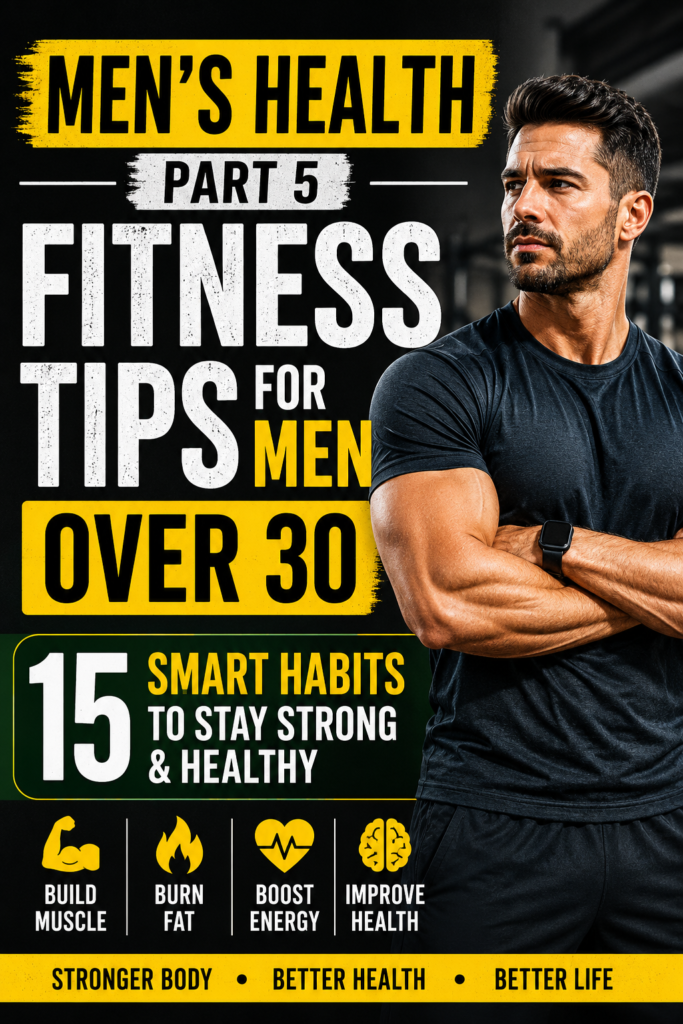
In a man’s life, the age of 30 is a time when, on one hand, career busyness peaks, family responsibilities increase, and there is the thought of securing the future. On the exact other hand, without our knowledge, a silent change begins to occur inside the body. After crossing the age of 30, many men notice that some changes are gradually coming to their bodies. Weight is not dropping as easily as before, fat is accumulating around the belly, fatigue is felt even with little work, and it is becoming difficult to run or do heavy work like before. Many think, “Age is increasing, so this is normal.”
But truth be told, along with age, our lifestyle is also largely responsible for this change.
Most men think after crossing the age of 30 that now they are getting older, so a little bit of a potbelly is normal. At this age, if you do not pay conscious attention to your body, then serious problems like diabetes, high blood pressure, heart disease, and bone erosion appear in later life.
Nowadays, most people work sitting in the office for a long time, do not exercise adequately, eat more fast food, stay under mental stress, and do not get enough sleep. However, the good news is—it is entirely possible to stay healthy and fit after 30. By following the right dietary habits, regular exercise, adequate sleep, and some healthy habits, one can lead a strong, active, and healthy life for a long time.
Fitness does not mean just going to the gym to make six-pack abs. The true meaning of fitness after the age of 30 is—maintaining the body’s functional capacity, retaining muscle and bone strength, improving energy levels, and staying mentally focused.
In this detailed blog, we will discuss why men should change their approach to fitness after 30, and furthermore, in this segment, we will know—
- What changes occur in the body after 30?
- Why does the importance of fitness increase even more from this time?
- Which type of exercise is most effective?
- What changes should be made to dietary habits?
- 15 smart fitness tips for men over 30
- Which mistakes should be avoided?
- When is a doctor’s advice necessary?
What changes occur in the body after 30?
When we cross the age of 30, some significant changes occur in our body’s internal hormonal and metabolic systems. It may not be the same for everyone, but most men experience some change or another.
1. Metabolism gradually decreases
Metabolism is the process through which the body converts food into energy. With increasing age, this process can slow down a bit. As a result, even if you eat the same food as before, extra calories start accumulating in the body as fat.
2. Muscle Mass begins to decrease
After 30, if you do not do regular Strength Training, the amount of muscle can gradually decrease. This condition is called Sarcopenia.
When muscle decreases—
- The body feels weak.
- Strength decreases.
- The risk of weight gain increases.
- Fatigue is felt even in daily activities.
3. Belly Fat begins to increase
For many men, the tendency of fat accumulating around the belly increases after 30.
Extra Belly Fat can increase the risk of—
- Type-2 diabetes
- High blood pressure
- Heart disease
- Fatty liver
- Sleep apnea
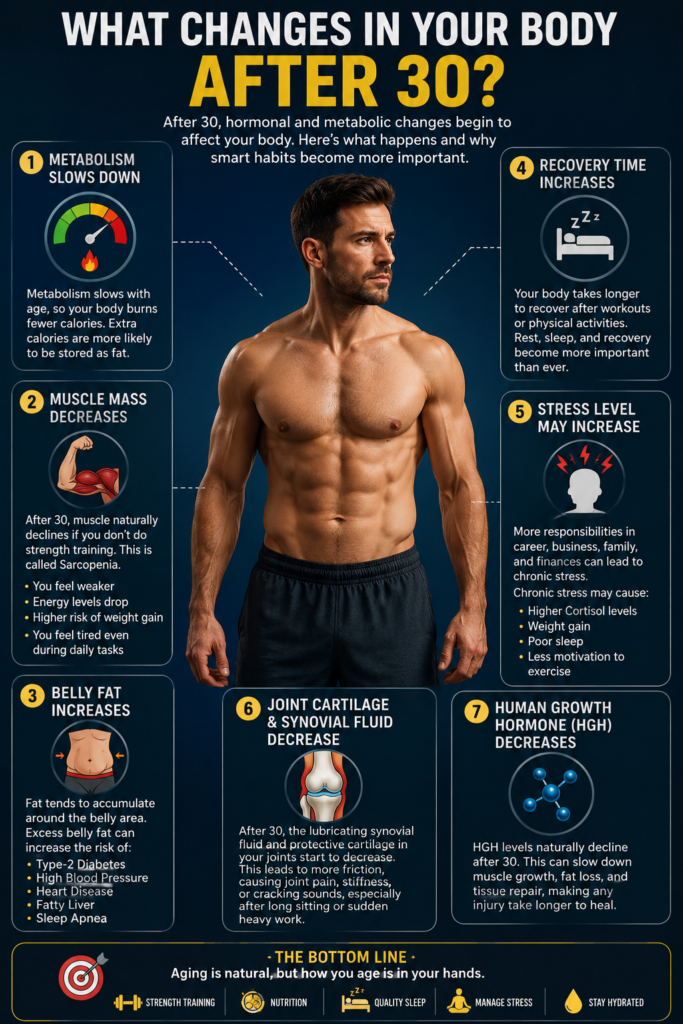
4. Recovery Time increases
Previously, after exercises where the body would recover in just one day, now it may take a little more time for the body to recover after the same exercise. Therefore, adequate rest and sleep become even more important than before.
5. Mental stress can increase
After 30, responsibilities regarding job, business, family, and finances increase in many people’s lives. As a result, long-term mental stress can affect the body.
If Stress remains for a long time—
- Cortisol can increase.
- Weight can increase.
- Sleep problems can occur.
- Interest in exercise can decrease.
6. Reduction of joint cartilage and synovial fluid
There is a type of lubricant between our bone joints, which is called synovial fluid. After the age of 30, this fluid and the protective cartilage of the bones gradually start to thin out. As a result, friction increases in the bone joints, and long-term joint pain or cracking sounds (clicking sounds of bones) appear when sitting for a long time or doing sudden heavy work.
7. Human Growth Hormone decreases
After the age of 30, the secretion of Human Growth Hormone (HGH) in our body naturally begins to decrease. Because this decreases, it takes more time for any injury or wound to heal for men over 30.
Why is regular exercise more important after 30?
Many people think, “My weight is fine, so I don’t need to exercise.” But fitness is not just for weight control. Regular exercise is highly important for your heart, muscles, bones, brain, and mental health as well. Especially after 30, exercise should be turned into a habit. Because from this time, the natural changes of the body gradually begin.
Regular exercise—
- Keeps the heart healthy.
- Strengthens muscles.
- Helips reduce extra fat.
- Keeps bones strong.
- Helps reduce the risk of diabetes and high blood pressure.
- Reduces mental stress.
- Helps in good sleep.
- Increases energy and stamina in the body.
- Helps improve the quality of life in the long run.
Which type of exercise is most effective?
After crossing 30, any one specific type of exercise alone cannot keep a man’s body completely fit. An exercise routine should be followed that will strengthen muscles, keep the heart healthy, and help stay healthy in the long run.
1. Strength Training (2–4 days a week)
It increases Metabolism, strengthens bones, and helps reduce Belly Fat.
Example:
- Squats
- Push-ups
- Deadlifts
- Bench Press
2. Cardio Exercise (150 minutes a week)
Cardio exercise keeps the heart and lungs healthy, burns calories, and helps in weight control.
Example:
- Brisk Walking
- Jogging
- Running
- Cycling
- Swimming
- Skipping
3. HIIT (High-Intensity Interval Training)
HIIT is highly effective for burning more calories in less time.
Example:
- 30 seconds Sprint
- 1 minute Walking
- Repeat for 15–20 minutes
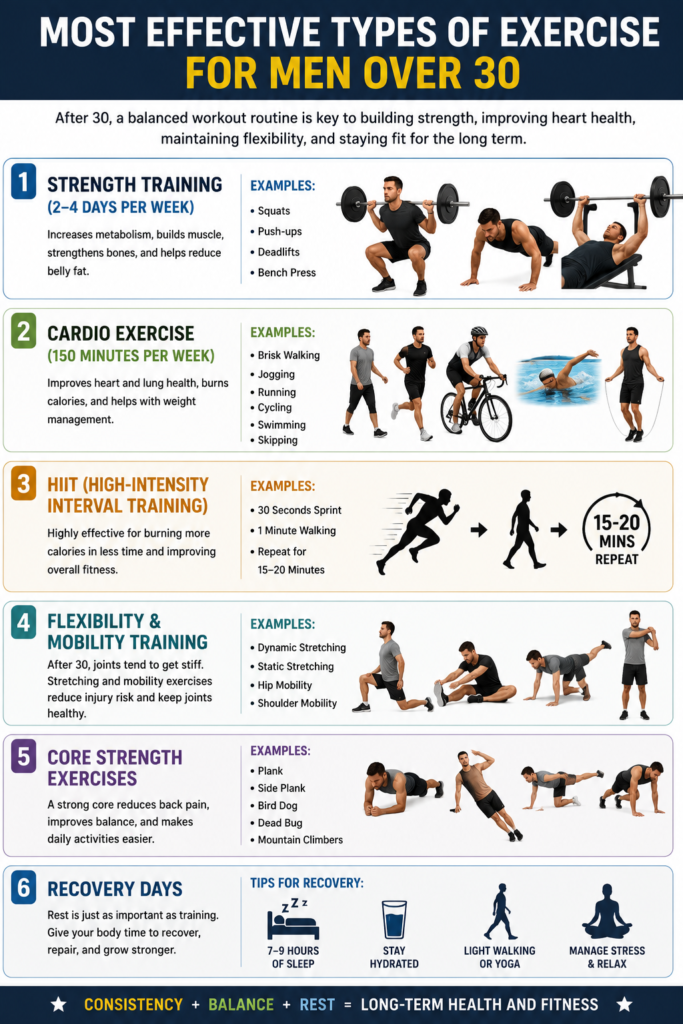
4. Flexibility & Mobility Training
After 30, our joints start becoming stiff. Doing Stretching and Mobility Exercise reduces the risk of Injury and keeps Joints healthy.
Example:
- Dynamic Stretching
- Static Stretching
- Hip Mobility
- Shoulder Mobility
5. Core Strength Exercises
A strong Core reduces back pain, improves Balance, and makes daily work easier.
Example:
- Plank
- Side Plank
- Bird Dog
- Dead Bug
- Mountain Climbers
6. Recovery Days
Heavy Workout should not be done every day. Give the body rest at least 1–2 days a week.
For Recovery:
- Sleep 7–9 hours
- Drink adequate water
- Do light Walking or Yoga
What changes should be made to dietary habits?
After the age of 30, our body’s Basal Metabolic Rate (BMR) slows down. It is necessary to bring some changes to food according to the body’s needs after 30.
1. Increase Protein Intake
Consume adequate Protein every day for muscle protection and Muscle Recovery.
Good sources:
- Eggs
- Fish
- Chicken Breast
- Lentils
- Soybean
- Greek Yogurt
- Paneer
2. Reduce Refined Carbohydrates
Reduce white rice, flour, and extra sugar, and choose Whole Grains.
You can eat:
- Oats
- Brown Rice
- Whole Wheat
- Millets
- Quinoa
3. Consume good fats or healthy fats
Excluding fat completely from the diet is a grave mistake. Good fat is needed for producing testosterone, the main hormone for men. Include foods rich in omega-3 fatty acids in your daily diet, such as—chia seeds, flax seeds (tisi), almonds, walnuts, and pure mustard oil or extra virgin olive oil.
4. Eat more Fruits & Vegetables
If you eat various fruits and vegetables daily, the body gets vitamins, minerals, and Antioxidants.
5. Reduce Added Sugar & Processed Foods
These are the main culprits for type-2 diabetes, fatty liver, and belly fat after 30. These foods suddenly increase insulin levels in the blood, which signals the body to store fat. Avoid extra Soft Drinks, Cakes, Biscuits, Fast Food, and Processed Meat.
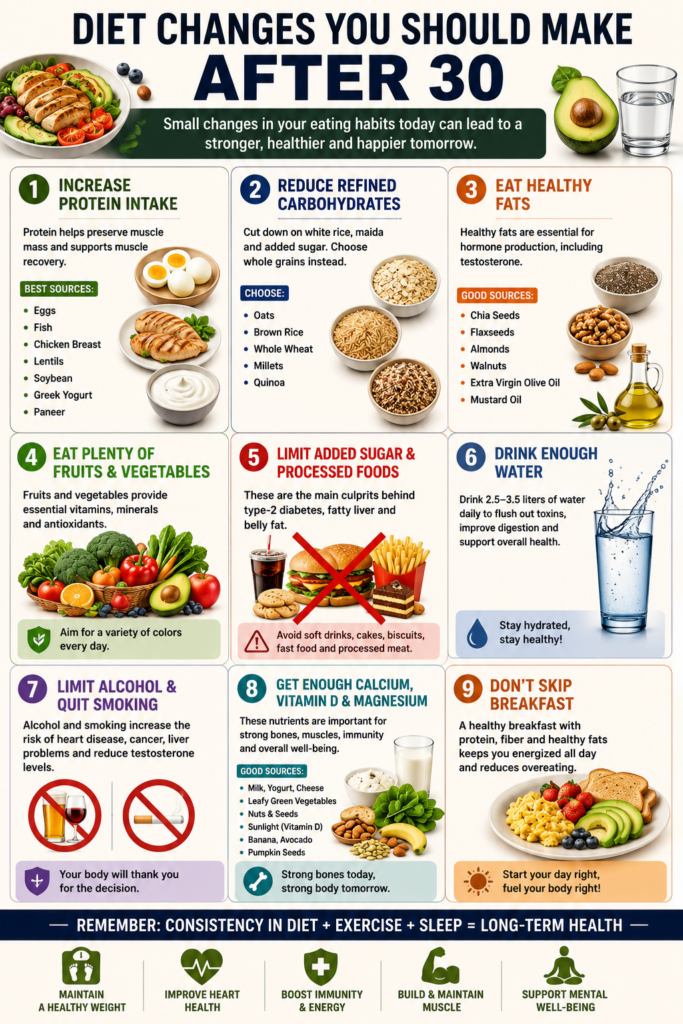
6. Drink adequate water
Try to drink 2.5–3.5 liters of water daily, which will help flush out toxins from the body.
7. Limit Alcohol and quit Smoking
These increase the risk of heart disease, cancer, liver problems, and low Testosterone.
8. Ensure Calcium, Vitamin D, and Magnesium
Just counting protein or carbohydrates will not do; deficiencies of zinc, magnesium, and vitamin D are very commonly seen in the bodies of men over 30. As age increases, these nutrients are extremely important for bones and muscles.
9. Do not skip Breakfast
Starting the day with a Breakfast rich in Protein, Fiber, and Healthy Fat maintains energy throughout the day and reduces the tendency to overeat.
15 Smart Fitness Tips for Men Over 30
1.Exercise at least 150 minutes a week: Do walking, cycling, jogging, or any other Cardio Exercise regularly.
2.Do Strength Training 2–3 days a week: This helps keep muscles strong and improve Metabolism.
3.Eat adequate Protein daily: Protein plays an important role in muscle building and rebuilding.
4.Sleep 7–9 hours daily: Good fitness is not possible without good sleep.
5.Drink adequate water daily: Hydration helps maintain normal body functions and exercise performance.
6.Do not sit continuously for a long time: Get up every 30–60 minutes and walk or do Stretching for a few minutes.
7.Relieve eye fatigue (Eye Fitness): When our optical nerves get tired due to excessive screen time, as a result, no energy remains in the body and the desire to exercise dies. Follow the 20-20-20 rule of looking at an object 20 feet away for 20 seconds every 20 minutes during work.
8.Control sodium and potassium ratio (Sodium-Potassium Ratio): A big reason for water retention (Bloating) and high blood pressure in men over 30 is the imbalance of sodium and potassium. Keep potassium-rich foods like coconut water, bananas, and spinach in your daily diet.
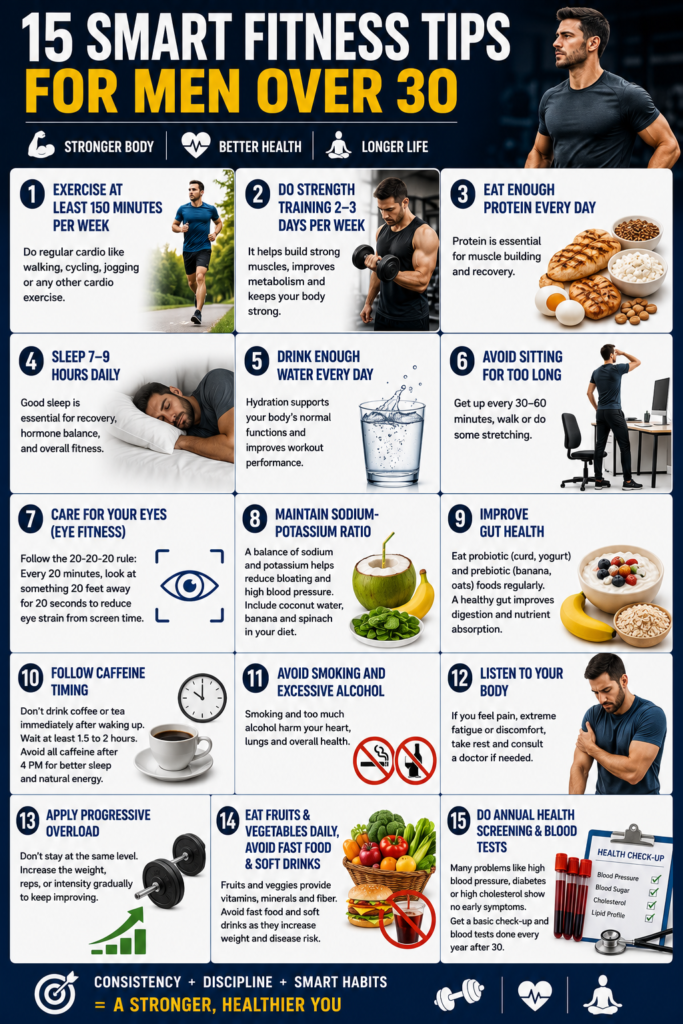
9.Improve gut health (Gut Health): After 30, the digestion process starts to weaken. Keep regular probiotic (like sour yogurt) and prebiotic (like banana, oats) rich foods in your diet. If the balance of gut bacteria is correct, nutrients from food are properly absorbed into the body.
10.Right timing of caffeine (Caffeine Timing): Many of us have a habit of having a strong cup of coffee or tea right after waking up in the morning. Upon waking up, cortisol hormone naturally increases in the body; consuming caffeine at this time destroys the body’s natural energy system. Therefore, the right time to have coffee or tea is at least 1.5 to 2 hours after waking up. And avoid any kind of caffeine after 4 PM.
11.Avoid smoking and excessive alcohol: These have a negative impact on the heart, lungs, and overall health.
12.Listen to the body’s signals: Rest if there is excessive pain, fatigue, or discomfort, and consult a doctor if necessary.
13.Progressive Overload: Do not keep your body stuck in the same level of exercise all the time. When the body becomes accustomed to a specific weight or speed, gradually increase its intensity.
14.Eat fruits and vegetables daily and give up Fast Food & Soft Drinks: Fruits and vegetables supply necessary Vitamin, Mineral, and Fiber to the body. On the other hand, extra sugar and processed food present in Fast Food & Soft Drinks can increase weight and the risk of various diseases.
15.Annual routine health screening and blood tests: Problems like high blood pressure, diabetes, or high cholesterol do not show any symptoms in the body in the initial stage. Therefore, rather than regretting after getting sick, it is a wise thing to get a basic blood and lipid profile test done at least once a year after 30.
Common Fitness Mistakes for Men Over 30
Many men start exercising with the desire to stay healthy, but do not get the expected results due to some common mistakes.
- Exercising excessively from the very first day
- Skipping Warm-up and Cool-down
- Doing only Cardio or only Weight Training
- Eating less Protein
- Not getting adequate sleep
- Losing patience
When should you consult a doctor?
Although exercise is generally safe, you should consult a doctor beforehand in some cases.
- If you have heart disease, high blood pressure, or diabetes.
- If chest pain, dizziness, or shortness of breath occurs during exercise.
- If there is pain in joints or muscles for a long time.
- If weight decreases or increases abnormally all of a sudden.
Conclusion
In our society, men often stay busy with calculations of bank fixed deposits, stock markets, or accumulated property. But they forget to take care of their own bodies. After 30, some natural changes come to the body; it is essential to be more caring toward one’s own body from this time. The care you give to your body today will yield a healthy, strong, and confident life in the future.
Remember, fitness is not a 30-day challenge; it is a lifelong healthy habit. Love yourself, take care of yourself, stay strong, and enjoy a healthy life!
FAQ
1. How many days a week should one exercise?
Ans. Try to do at least 150 minutes of Moderate Exercise and 2–3 days of Strength Training a week.
2. Is it too late to start Fitness after 30?
Ans. Not at all. There is no specific age to start a healthy lifestyle.
3. Is a Protein Supplement necessary for everyone?
Ans. No. Most people can get adequate Protein from a balanced diet. If a Supplement is needed, consult a doctor or a Registered Dietitian.
4. Why does losing weight seem so difficult after 30?
Answer: After 30, metabolism begins to slow down in our body and muscle loss (Sarcopenia) occurs. As a result, losing weight seems difficult at this age without proper diet and strength training.
5. I have a lot of work pressure, how do I start these habits?
Answer: There is no need to start 15 habits all at once. First, choose just 2 easy habits, such as—having coffee 2 hours after waking up and walking barefoot for 15 minutes a day. Once these become habitual in your routine, gradually add other habits.
6. Do I need to get a health checkup even if I don’t have any illness?
Answer: Of course. Problems like high blood pressure, diabetes, or high cholesterol do not show any symptoms in the body in the initial stage.
Disclaimer
The information provided in this article is for educational and informational purposes only and should not be considered medical advice, diagnosis, or treatment. Always consult a qualified doctor or healthcare professional regarding any medical concerns, symptoms, or before making changes to your diet, exercise, or treatment plan. Never ignore professional medical advice or delay seeking treatment based on information from this website. Healthyora and the author are not responsible for any decisions or actions taken based on the content of this article.